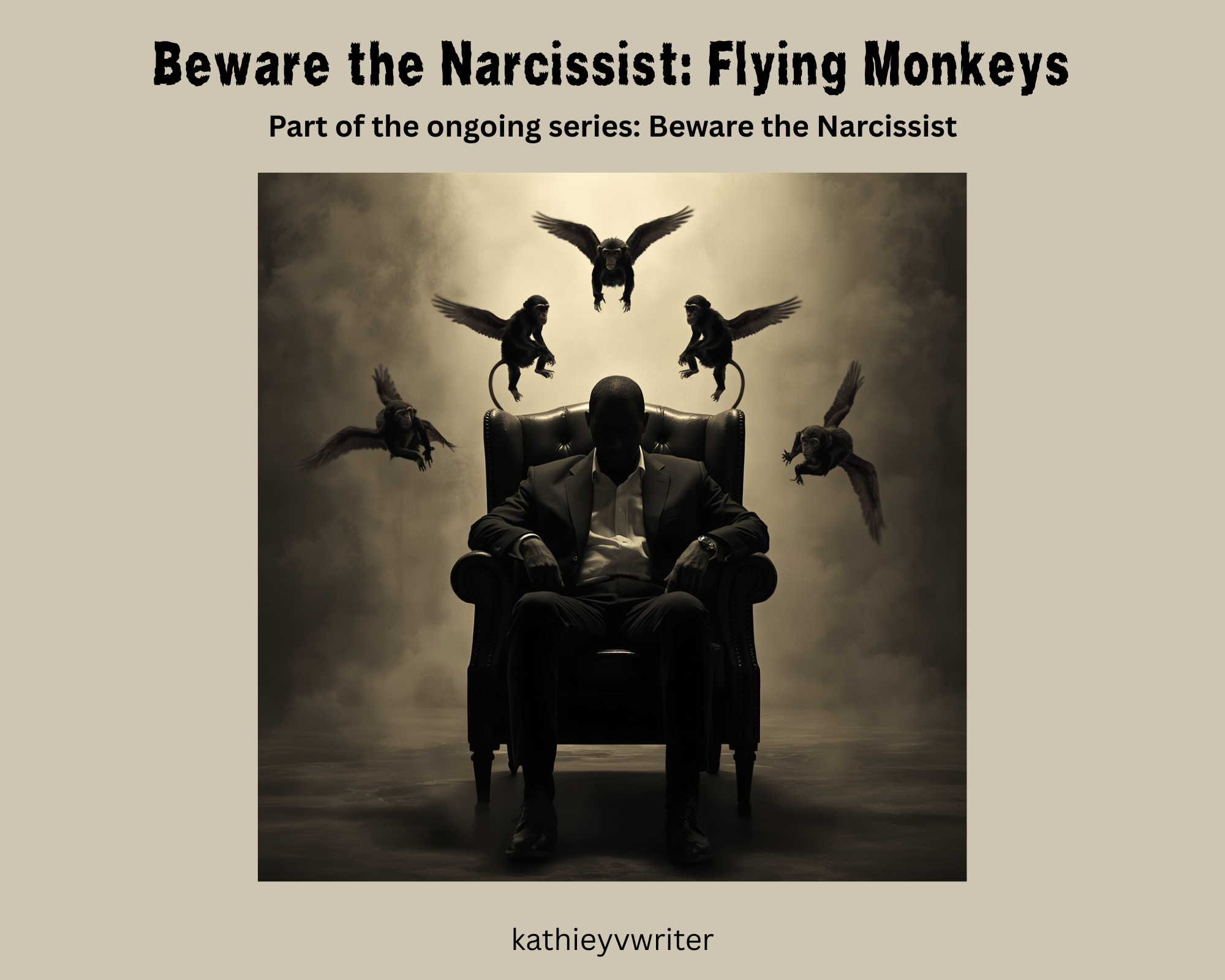
Beware the Narcissist: Flying Monkeys
Part of the ongoing series: Beware the Narcissist

I research narcissism because divorce touches millions of lives every year, and far too many people going through that process have encountered it without ever having a name for what they experienced. In fact, one notable analysis of 3,200 divorce records found that in 87% of cases where a spouse felt completely blindsided, the other partner exhibited covert narcissistic traits that had been carefully masked during the marriage.
That statistic stopped me in my tracks when I first came across it. Blindsided. That word says everything. You thought you knew this person. And then, almost overnight, everything unraveled in ways you could not explain.
If that resonates with you, this post is for you. Today we are talking about one of the narcissist’s most effective and most painful tools: flying monkeys.
What Is a Flying Monkey?
The term comes from The Wizard of Oz, where the Wicked Witch sends her flying monkeys to do her bidding while she stays safely in the background. In the world of narcissistic abuse, the concept is almost exactly the same.
A flying monkey is a person recruited by a narcissist to carry out their “dirty work.” While the narcissist maintains a carefully constructed image of innocence and victimhood, the flying monkeys do the heavy lifting. They spread rumors. They show up to guilt-trip you. They ask innocent-sounding questions that are really intelligence-gathering missions. And they stir up drama within your social circle, quietly and systematically cutting you off from the people who might otherwise stand by your side.
This is not random chaos. This is a deliberate strategy.
Not Everyone Knows They Are a Flying Monkey
Here is the part that is hardest to sit with. Many of the people carrying out the narcissist’s agenda have no idea they are doing it.
Mental health experts identify four common types of flying monkeys:
The Deceived. These are genuinely well-meaning people who have heard the narcissist’s version of events and believe every word of it. They think they are helping resolve a misunderstanding. They see themselves as peacemakers. What they do not realize is that they are operating on completely false information.
The Fearful. These individuals sense that something is not quite right, but they comply anyway. Going along feels safer than becoming the narcissist’s next target. Fear is a powerful motivator, and narcissists know exactly how to use it.
The People-Pleasers. Conflict is unbearable for these folks. They want everyone to get along, and they feel a sense of importance from being in the narcissist’s inner circle. They play along without asking the hard questions because asking would cost them something they are not willing to lose.
The Enablers. These ones are fully aware of what is happening. They align with the narcissist for personal gain, whether that is power, access, or simply the satisfaction of being on the winning side.
Research from the CPTSD Foundation illustrates just how far this can reach. Family members, sometimes even parents or adult children, can be woven into the narcissist’s web without realizing it has happened. A narcissist might use phrases like “I just want what is best for everyone” or “I am trying, but they make it so difficult,” planting seeds of doubt in the minds of people who care about both parties. Over time, those seeds grow into suspicion, and the person being targeted finds themselves increasingly isolated from the people they trusted most.
That isolation is not a side effect of the conflict. It is the goal.
What This Does to You
Living through a flying monkey campaign is deeply disorienting. You start to question your own reality. You wonder who you can trust. You watch relationships quietly deteriorate and you cannot fully explain why. Mental health professionals note that this kind of prolonged isolation and betrayal can trigger or deepen Complex PTSD, eroding your sense of self-worth, your ability to trust others, and your connection to your own community.
If that sounds familiar, please hear this: what you experienced was not paranoia. It was not you being overly sensitive or dramatic. It was a coordinated, calculated form of emotional abuse. And you are far from alone in it.
How to Protect Yourself
Mental health experts offer several practical strategies for navigating flying monkey dynamics:
Set firm boundaries. Be clear about what you will and will not discuss. If someone continues to press you on behalf of the narcissist, it is okay to limit or end that contact entirely. You do not owe anyone access to your pain or your personal life.
Avoid JADE. That stands for Justify, Argue, Defend, Explain. It is incredibly tempting to try to tell your side, to make people understand, to set the record straight. But flying monkeys are often deeply invested in the narcissist’s narrative. Your energy is precious. Do not pour it into a cup with a hole in the bottom.
Try the Gray Rock Method. If you must interact with someone you believe is reporting back to the narcissist, keep your responses short, neutral, and unremarkable. Give them nothing interesting to carry back. Become, as the name suggests, as dull and uninteresting as a gray rock.
Seek professional support. This is not something anyone should have to process alone. A therapist who specializes in narcissistic abuse can help you make sense of what happened and begin rebuilding the trust that was taken from you. Communities like STAR Network’s TAR Anon fellowship exist specifically for survivors navigating these exact dynamics.
Before You Go
I research narcissism and share what I find because awareness is protection. The more clearly you can see these patterns for what they are, the less power they hold over you. This series is not about pointing fingers at any one person. It is about giving you the language, the knowledge, and the validation to make sense of experiences that may have left you questioning your own reality.
If this post helped you, share it with someone who might need it. You never know who in your world is quietly trying to make sense of the very same thing.
And if you are new here, welcome. We talk about hard things in this space, and then we go looking for joy anyway.
Follow the Beware the Narcissist series for ongoing, research-based awareness of narcissistic abuse tactics.
Disclaimer: This post is intended for educational and awareness purposes only. It is based on published research and expert mental health guidance and does not reference or implicate any specific individual.